About
An independent media project about human creativity, craft and possibility.
For curious people who want to look beyond the finished work — to understand the stories, processes and people behind it, appreciate it more deeply, and expand their own sense of what is possible.
Through videos, interviews, essays, photography and experiments, we spend time with the work: how it was made, what shaped it and what it means to the people behind it — so you can experience it more deeply and carry something into your own thinking, work or creative practice.
The project grew from Trevor Menard's experience across business operations, systems and technology, alongside the creative worlds of music, film, photography, art and design. Across those worlds, the same pattern kept appearing: pay attention, learn how something works, exercise judgment, and use what you know to make or improve something.
What follows are a few notes from the founder on the philosophy behind See Think Create — and the perspective shaping the stories, people and ideas explored here.
Philosophy · 01
The method behind the name
See. Think. Create. draws inspiration from the classical Trivium, an ancient method of learning organized around three parts:
Grammar. Logic. Rhetoric.
- First, acquire the language and facts of a subject.
- Then learn to reason about them.
- Finally, develop the ability to express, argue, teach or create with what you understand.
Another way of putting it is input, analysis, output. Or: See. Think. Create.
The principle underneath it is not learning for its own sake. It is becoming more capable:
Learn how to learn — then make something of what you understand.
Once you understand how to learn, new subjects and skills become more accessible. The habits carry forward: observe clearly, reason carefully, practise deliberately and use what you learn. The goal is not knowledge for its own sake. It is becoming more capable of understanding the world and taking an active part in shaping it.
We begin with respect for the work and the people behind it. We share the roots and knowledge it carries not to reduce the work to a formula, but to help appreciation inform what someone else understands or creates.
02
The autodidact
Institutions can be extraordinarily useful. So can teachers, apprenticeships, communities and experts.
But learning ultimately becomes personal. At some point, curiosity has to survive without someone assigning the next chapter.
- You have to learn how to notice what you don't understand.
- How to find the people and material that can teach you.
- How to separate a compelling idea from a correct one.
- How to test what you think you know.
- And eventually, how to turn understanding into something of your own.
Self-education is not about knowing everything. It is about becoming able to enter unfamiliar territory, build sound judgment and use what you learn.
03
We make with what we inherit
Self-directed does not mean self-made.
We are born into a world surrounded by the accumulated work of people who came before us.
We speak languages we didn't invent. We play instruments we didn't design. We adopt techniques refined across generations and lifetimes.
We build with scientific discoveries, musical traditions, architectural forms, machines, software and ideas. We even inherit mistakes somebody else already paid for.
Even our most original work is made with an inheritance.
We learn what came before, then decide what to preserve, change or combine.
This is why SEE comes before CREATE. Looking closely at what came before helps us understand the work in front of us — and gives us a stronger foundation for making what comes next.
Not every work needs to become a lesson. Sometimes understanding its roots simply lets us experience it more fully.
04
Across disciplines
See Think Create explores widely across disciplines. Why?
Because an idea or method from one world can change what someone understands or creates in another.
Creativity appears in a melody. A photograph. A building.
But also in a manufacturing process someone redesigned after noticing everyone else had accepted the wrong constraint. In a chef's technique. In an interface. In a tradesperson solving something with the materials at hand.
In a business whose systems allow talented people to do their best work. In a piece of technology that turns something previously difficult into something ordinary.
These things shouldn't be flattened into the same discipline. Their differences are part of what makes them interesting. But looking across them reveals recurring qualities:
Attention. Skill. Judgment. Constraint. Taste. Experimentation. Accumulated knowledge.
And sometimes an idea discovered in one world becomes unexpectedly useful in another.
05
Human agency
With all the beauty and might of what humanity has created, we now stand at a moment of tremendous potential. But with that potential comes risk.
The printing press changed how we thought by widening access to ideas and transforming how they travelled.
Photography changed how we see and what could be preserved.
Audio recording changed how we hear, remember and imagine what music can be.
Computers changed how we calculate, organize information and create.
The internet changed how we connect, learn and share ideas across distance.
And now AI is changing cognitive and creative capability itself.
Machines can now provide seemingly boundless creative output. That creates a real divide.
We can use them in ways that let our own muscles atrophy, or in ways that strengthen our autonomy, creativity and capability.
The central question is what kind of relationship we choose to have with increasingly capable tools.
Will they merely replace effort, or extend curiosity, judgment, learning and expression? Which frictions are useful to remove, and which capabilities are worth continuing to exercise? What should remain slow and deliberate? What is the value of creation itself?
There is a version of the technological future where convenience becomes passivity. Where fewer people understand the tools, systems and institutions shaping their lives. Where creation increasingly means requesting an output.
That is not a future we have to accept.
There is another possibility. A person with curiosity and judgment can suddenly access teachers, research, tools, collaborators and forms of production that once required far more money, geography, institutional access or specialized infrastructure.
An individual can move between disciplines: learn something unfamiliar, prototype an idea, make a film, build software, understand a business, or reach someone on the other side of the world.
The tools themselves are not the point. What a person becomes capable of doing with them is.
A more hopeful future is one where increasingly powerful technology produces more capable individuals, not merely more capable systems.
As machine-made output becomes faster and more abundant, the human creative force becomes more — not less — worth savoring, celebrating and strengthening.
06
Our mission
Our role is to bring you closer to people who make things with care, curiosity, skill and a point of view — and to the knowledge carried in their work.
We approach their work with curiosity and respect, asking how it came to be and sharing what we learn so you can experience it more deeply and make something of the ideas that stay with you.
Some work offers a lesson we can use. Some asks to be questioned or carried forward. And some is valuable simply because a person brought something beautiful into the world.
This project is a love letter to people who keep paying attention, keep learning, and keep making — and to the knowledge and beauty their work puts into the world.
Through:
Videos. Conversations. Essays. Experiments. Field notes.
The format can change. The curiosity stays.
07
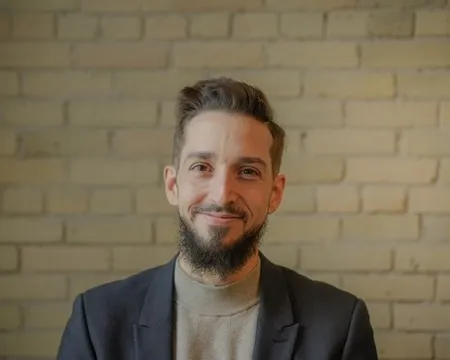
Trevor Menard
Founder & host
I've spent much of the last decade working closely with businesses, creatives, designers and tradespeople, trying to understand not only what makes great work possible, but what allows it to become real.
Inside companies, that often meant going deep into operations: how information moved, where decisions stalled, what systems supported people well, and what was quietly getting in their way.
But alongside that work, I've been equally immersed in the things that have shaped how I see the world: music, film, photography, art, philosophy and psychology.
Over time, those worlds stopped feeling separate.
- I saw how much extraordinary creative work depends on invisible systems.
- How much great business depends on imagination, judgment and taste.
- How often a person's best work is built from ideas and tools inherited from people they may never have met.
- And how much is lost when we stop paying attention to any of it.
See Think Create grew out of that convergence.
It's a place to explore the strongest parts of those worlds together, and is dedicated to the beauty, knowledge and creative forces that came before us, exist around us now, and will continue as long as people keep making things.
08
Let's explore this together.
Follow along for videos, conversations, essays and experiments that bring you closer to the people and knowledge behind the work — and give you something to carry into what you do next.
Making something worth understanding — or know someone who is? Collaborate